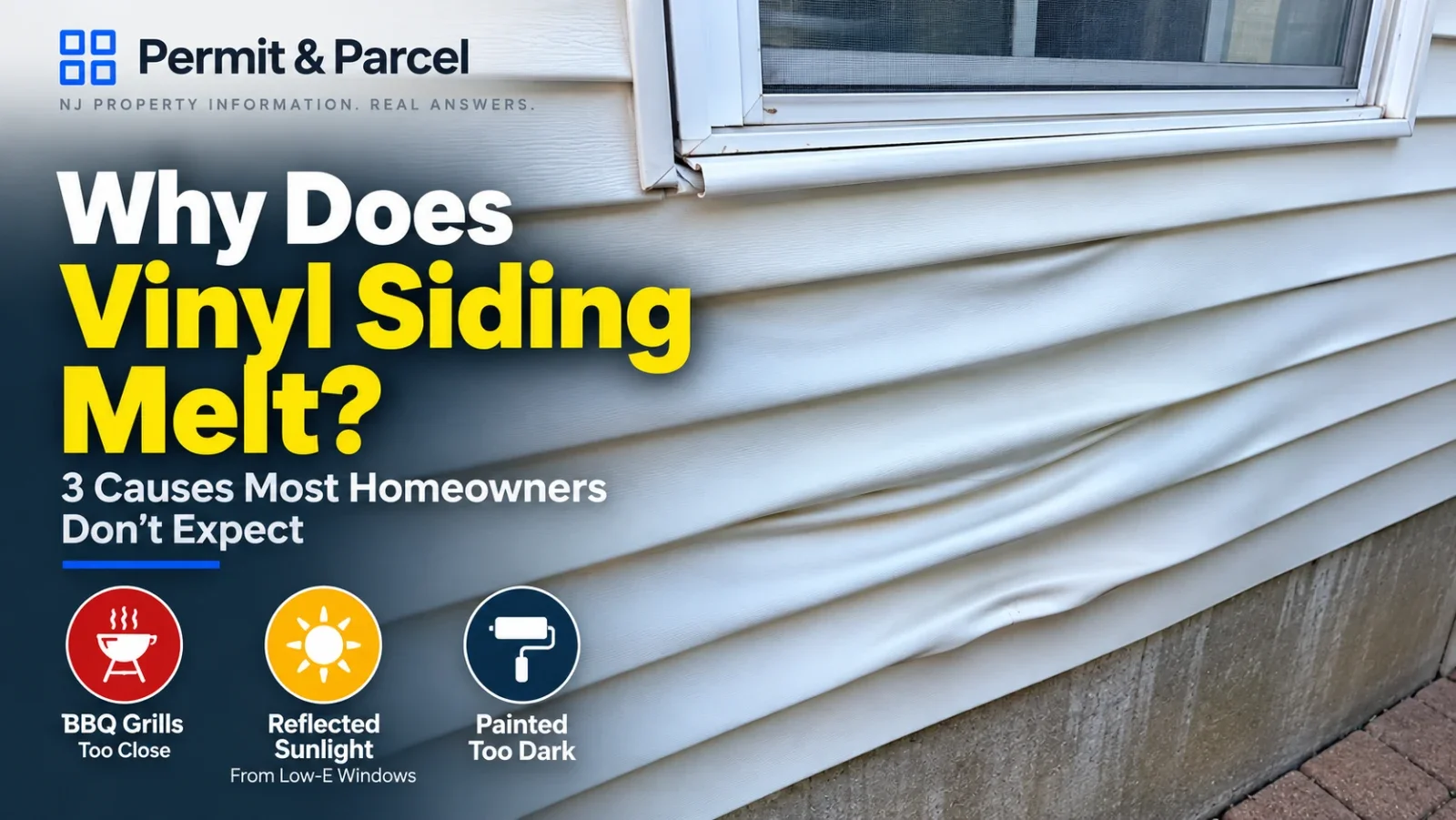
Vinyl siding can look like it genuinely melted on a house that has never had a fire. Warped, rippled, sagging, sometimes with a shiny glazed look to it, and no scorch marks anywhere.
When I find that on an inspection, I don't start with the siding. I start with the pattern. How high off the ground is it? Is it one concentrated patch or most of a wall? What is sitting across from it?
The pattern is what tells you the cause, and the cause is what tells you whether new siding will survive.
First: it isn't really melting
Vinyl siding is a thermoplastic. It doesn't have to burn to fail. It only has to get hot enough to go soft, and once it does, it slumps and cools back into the new shape. That threshold is a lot lower than people assume: rigid vinyl starts to distort somewhere in the neighborhood of 160 to 165°F, which is well within what a dark wall or a reflected beam of sun can reach on a summer afternoon.
That's why "melted" siding usually has no soot, no charring and no smell. It was never on fire. It just got soft.
Three heat sources cause nearly all of it.
1. A grill parked too close to the wall
The easy one.
A grill doesn't have to touch the siding, and nothing has to catch fire. Radiant heat off the firebox and the heat rolling up off the lid are enough on their own, and a grill pushed back against the house on a small deck sits inches from the wall.
What it looks like: a concentrated patch, low on the wall, roughly at and above grill height, usually beside a deck, patio or back door. It fades out as you move away from that spot. It doesn't spread across the whole elevation.
The catch: the grill is often long gone. You are looking at damage from three summers ago with nothing to point at. That's when height and spread do the work for you.
Worth saying out loud to homeowners: siding soft enough to deform is also a fire-clearance problem. Follow the grill manufacturer's clearance to combustibles, and if the deck layout doesn't allow it, the grill needs to move, not the siding.
2. Sunlight bouncing off a Low-E window
This is the one that surprises people, and the one I see misdiagnosed most.
Low-E glass carries a coating that reflects heat energy, which is exactly what you want for the energy bill. But glass that is slightly bowed, either by manufacturing or by pressure differences between the panes, stops reflecting sunlight in a flat sheet and starts focusing it, the way a shaving mirror does. The concentrated beam lands on a narrow strip of wall and can push surface temperatures well past what vinyl tolerates. Readings over 200°F have been documented on siding hit this way.
What it looks like: a band or an oval of distortion, often several feet off the ground, with no grill, no dryer vent, no AC condenser, no heat source of any kind nearby. Frequently on a wall that faces another building.
The twist: the window is often not on the damaged house. It's the neighbor's. A beam crossing a side yard does this happily.
The other twist: it may only happen for an hour a day, and only during part of the year. The sun's angle moves, so the beam moves. If you go looking at the wrong time you will find nothing, and the homeowner will swear the damage appeared out of nowhere.
So when the damage has no explanation on the wall itself, turn around. What faces it? Where are the windows? Does the shape of the damage match a reflection more than a fire?
Fixes here are about blocking the beam, not the siding: an exterior screen or awning on the reflecting window, a strategically placed tree or tall shrub, or in stubborn cases a film applied to the offending glass. Replacing the siding while the beam still lands there just buys you a repeat.
3. Somebody painted it a darker color
This one is interesting because it was created by an improvement.
A light-colored panel was engineered around how much solar energy a light surface absorbs. Repaint it charcoal, navy or deep brown and the same panel in the same sun now runs hotter than it was ever designed to run. It warps, buckles, ripples, and pulls at the nails.
You can paint vinyl siding, but the paint product and color matter. Some manufacturers offer vinyl-safe paint systems specifically formulated to reduce excessive heat buildup, including certain darker colors.
Before painting vinyl siding, check the paint manufacturer's approved vinyl-safe color range and, when available, the siding manufacturer's requirements. Choosing a dark color simply because it looks good can cause the siding to absorb more solar heat than it was designed to handle.
This is especially important when older, light-colored vinyl siding is being repainted a substantially darker color.
What it looks like: widespread, fairly even distortion across the sun-exposed elevations, south and west walls first, on siding that is visibly darker than the cut edges, the trim, or the panel backs.
Read the pattern
Finding warped siding is easy. Working out why is the part that matters:
- Small, concentrated, low on the wall, near a deck or patio. Look for a heat source. Grill first.
- A band or oval partway up a wall with nothing around it. Look across the yard for glass facing it.
- Widespread, even, on the sunny elevations, on repainted siding. Look at the color and ask what shade it was originally.
None of those is proof by itself. Combine the location, the shape, what surrounds it and what the homeowner remembers, and you're usually close.
Don't just replace the siding
Replacing the damaged panels solves half the problem, the visible half.
- If the grill goes back in the same corner, the new siding takes the same heat.
- If the window keeps focusing sun on the same strip of wall, the new siding distorts on the same schedule.
- If the wall gets repainted the same dark color with the same paint, you have rebuilt the original condition.
So when vinyl siding looks like it melted for no reason, don't only look at the siding.
Look at what's around it. Sometimes the cause is sitting three feet away. And sometimes it's a window across the yard, for one hour a day, in August.