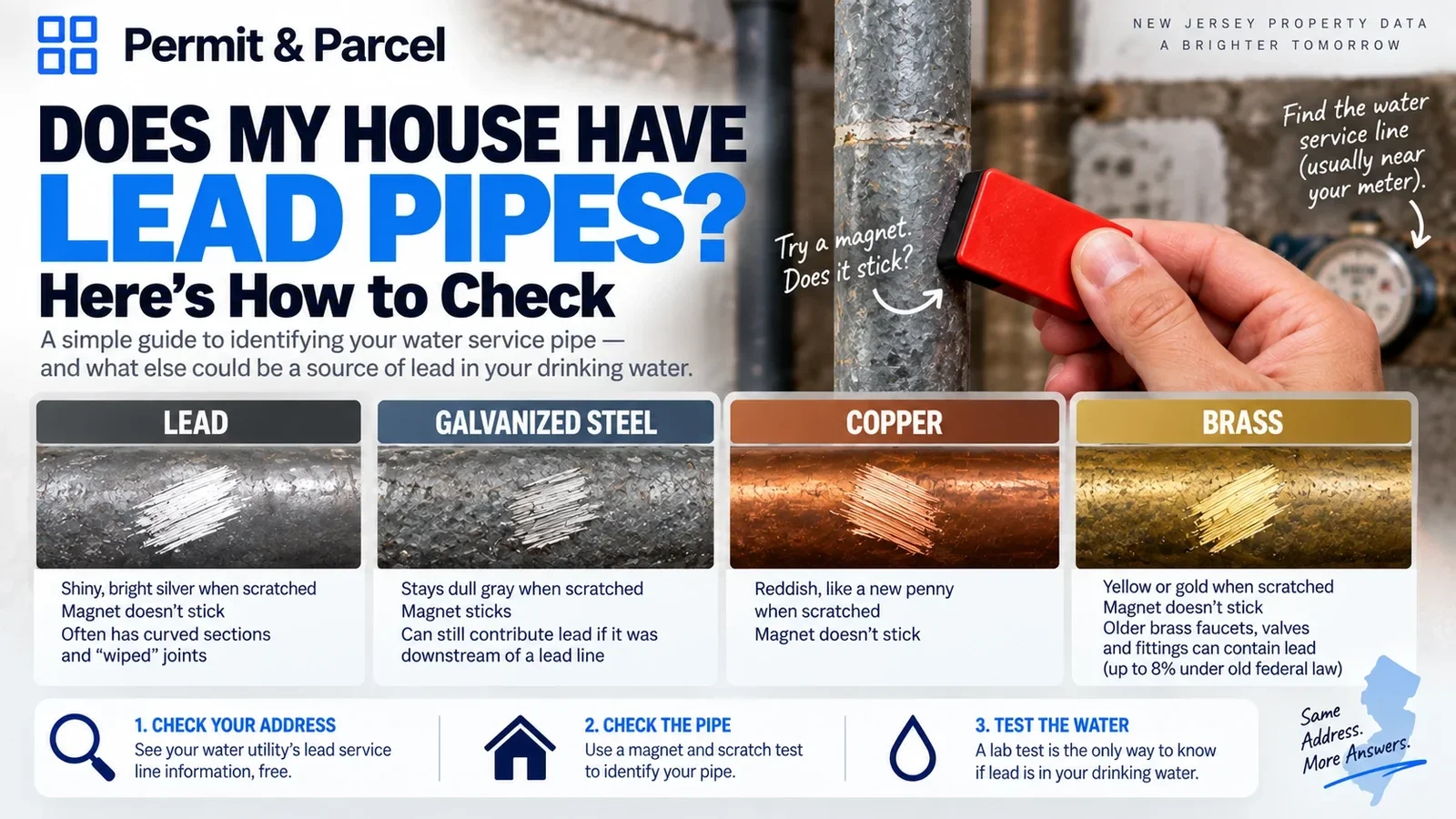
If you own an older home, you've probably wondered: does my house have lead pipes? Maybe you looked in the basement, saw copper or galvanized steel plumbing, and figured you were in the clear.
It's not that simple. Lead can come from the service line bringing water into the house, but it can also come from older solder, faucets, valves, and brass fittings. In homes that do have a lead service line, though, that line is typically the largest single source.
The good news: there are a few simple ways to get a much better idea of what your service pipe is actually made of.
First: Find the Right Pipe
Don't start by examining every pipe in the basement. Find the water service line, the pipe that brings water in from the main. If your meter is inside the house, follow the pipe from where it enters through the foundation wall or floor to where it connects to the meter. That's the pipe you care about.
The Magnet Test
Grab a refrigerator magnet and hold it against the exposed metal service pipe.
- Sticks: likely galvanized iron or steel, not lead.
- Doesn't stick: don't assume lead yet. Copper, brass, and lead are all non-magnetic, so this only narrows things down.
The Scratch Test
Use a coin or key to gently scratch a small, already-exposed section of the pipe (nothing sharp enough to gouge it) and look at the metal underneath.
| Material | Scratched appearance | Magnet |
|---|---|---|
| Lead | Shiny, silver | Doesn't stick |
| Galvanized steel | Stays gray/silver-gray | Sticks |
| Copper | Reddish, like a new penny | Doesn't stick |
| Brass | Yellow or gold | Doesn't stick |
Lead service lines often have a few other tells too: curved sections and rounded, "wiped" joints rather than the crisp fittings you'd see on copper or steel.
"It's Galvanized, So No Lead, Right?"
Not necessarily, and this is the part most homeowners miss.
The galvanized pipe itself isn't lead. But if galvanized piping is or was downstream from a lead service line or lead connector, lead can accumulate in corrosion inside the galvanized pipe and later be released into the water. New Jersey goes further than that: under the state's Lead Service Line Replacement Law, a galvanized service line is classified as a lead service line outright, and it's subject to the same statewide replacement requirement.
So a magnet that sticks doesn't automatically close the case.
The Pipe Isn't Lead. But What About the Fittings?
This one surprises a lot of people. Older brass faucets, valves, and fittings can contain lead. For years, federal law allowed certain plumbing components containing up to 8% lead to meet the legal definition of "lead free." In other words, historically, "lead free" didn't necessarily mean zero lead.
The federal standard has since become much stricter. Today, the definition generally limits lead to a weighted average of 0.25% across the wetted surfaces of pipes, pipe fittings, plumbing fittings, and fixtures.
That's one reason a house with no visible lead service pipe can still contain plumbing components capable of contributing lead to the water.
What About the Solder?
Copper piping doesn't automatically mean zero lead either. Older copper plumbing was commonly joined using solder that could contain lead. The EPA identifies lead solder, older brass or chrome-plated brass faucets and fixtures, and lead service lines as potential sources of lead in drinking water.
So seeing copper throughout the basement is certainly encouraging, but it doesn't tell you the entire story.
Can You Tell Just by Looking?
No.
Identifying the pipe material can tell you whether certain potential sources of lead are present. It cannot tell you how much lead, if any, is actually in your drinking water. Water containing lead can look, smell, and taste completely normal.
A laboratory water test is the way to determine whether lead is present in the water sample.
A 5-Minute Check You Can Do Today
Find where the water service enters your house, usually near the water meter. Then:
- Try a magnet.
- Gently scratch a small exposed area with a coin or key.
- Look at the color of the freshly exposed metal.
- Shiny silver, magnet doesn't stick → possible lead
- Gray, magnet sticks → likely galvanized steel
- Penny-colored, magnet doesn't stick → likely copper
- Yellow/gold, magnet doesn't stick → possibly brass
If you're not sure, don't guess. Your water utility or a qualified plumber can help identify the material. And if your concern is whether there's actually lead in your drinking water, have the water tested.
One Pipe Doesn't Tell the Whole Story
Here's the biggest thing to remember:
Copper at the meter doesn't necessarily mean the entire service line is copper. And no visible lead pipe doesn't mean every fitting or connection in the house is lead-free. Older homes are often a patchwork of plumbing materials installed during different decades.
That's why it's worth checking both what you can physically see and what your water utility has on record.
Want a Shortcut? Check Your Address
Before you start scratching pipes, you may be able to find out what your water utility already has listed.
Permit & Parcel lets you look up your New Jersey address and check available lead service line inventory information for free, no account needed. The information comes from utility service-line inventories and may show whether the service line is listed as lead, galvanized, non-lead, or unknown.
Just remember: a utility inventory is not the same thing as a water test. Think of it as another piece of the puzzle.
Check the records. Check the pipe. And if you're concerned about what's actually in the water, test the water.
Sources & Learn More
Information in this article is based in part on guidance from the U.S. Environmental Protection Agency (EPA) and the New Jersey Department of Environmental Protection (NJDEP).
- NJDEP — Service Line Identification: How to identify lead, galvanized steel, copper, and other service-line materials using visual inspection, a magnet, and a scratch test.
- NJDEP — Lead Service Lines in New Jersey: Information about New Jersey's service-line inventory and replacement requirements.
- U.S. EPA — Basic Information About Lead in Drinking Water: Information about lead service lines, lead solder, brass fixtures, and other potential sources of lead.
- U.S. EPA — Lead-Free Plumbing Requirements: Current and historical federal limits on lead content in pipes, fittings, fixtures, solder, and flux.